Showing posts with label Books. Show all posts

Tuesday, February 9

Franz Kafka, Occasional Belletrist

Quick, now. I say Franz Kafka, and the first thing you think of is probably ... a cockroach—and one with a funny name like Gregor. But for a little while perish the thought of creepy, if sensitive, crawlers and consider this: that, as today's Writer's Almanac points out in its first installment of love letters to welcome Valentine's Day, Kafka "wrote a great many love letters—many of the anguished, helpless variety—to a Berlin woman [Felice Bauer] to whom he was engaged for five years. Their relationship was carried out almost entirely by letters." (He was engaged to Ms. Bauer twice, and separated from her twice.)

A few of the rosier stretches in his missives are featured in the WA link above. But there are also more familiar Kafka-esque stretches to recall, such as this:
The life that awaits you is not that of the happy couples you see strolling along before you in Westerland ... no lighthearted chatter arm in arm, but a monastic life at the side of a man who is peevish, miserable, silent, discontented, and sickly; a man who, and this will seem to you akin to madness, is chained to invisible literature by invisible chains and screams when approached because, so he claims, someone is touching those chains.
In his mind, too, Felice has become wrapped up in his writing:
Lately I have found to my amazement how intimately you have now become associated with my writing, although until recently I believe that the only time I did not think about you at all was while I was writing.
At the same time Felice was to him the suggestion of a life he might lead beyond work, of a life inching toward something like normalcy—"happy couples" and "their light-hearted chatter" and so on. But as a NYT review of a 1988 reissue of Kafka's love letters, which you can purchase here, remarked,
[Kafka] returned to the solitude he felt so necessary for his work. He apparently believed Yeats's dictum that ''the intellect of man is forced to choose/ Perfection of the life, or of the work'' and in the end, he embraced the latter.

While we are on the subject of letters, make sure to buy a copy of Yours Ever: People and Their Letters, the latest scrumptious book from the pen of journo-turned-novelist Thomas Mallon.

Friday, January 22

Picture Book: André Kertész's 'On Reading'

Tonight I've picked up my small white edition of André Kertész's sparsely titled On Reading, first published, lushly, in 1971 and reprinted, not so lushly, in 2008. With photographs as beautiful and intimate as his, it seems only proper to share a few of them with you in our corner.

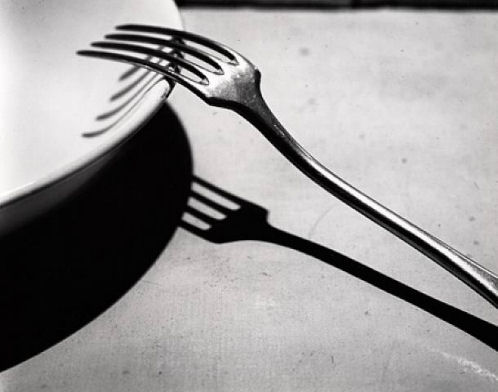
Perhaps you are already familiar with his work, such as this one of a perfectly poised fork or this one, of a patch of street at the Eiffel Tower's feet; either way, his is a pleasant ouevre to view and view again. I have also enjoyed his pictures of bodies distorted in mirrors, such as this one from 1933, Distortion, making limbs look like statuesque taffy or Henri Moore sculptures or, at times, black-and-white snip-its of Dali paintings. As is the case with ruins, there is an unexpected comfort in seeing the human form warped, disfigured—and still harmonious. In fact, of the Parthenon, Moore wrote the following upon his visit to it in 1951: "In fact I would say that the Parthenon now is probably much more impressive than when it was first made. You feel the spaces much more, and the openings, and the fact that it’s not solid throughout and that the light comes in, makes it into a piece of sculpture and not, as it was before, a building with four external sides. It’s completely spatial now—a different object altogether.” Can you imagine a more hopeful way of considering things in ruin? His sentences make one think the Parthenon's time spent as a temple, cathedral, mosque, and then as an ammunition storehouse was not in vain.
But back to the book. It's exclusively of people of all sorts—gondoliers at rest, girls dressed backstage as fairies, boys dressed as men in overcoats, sunbathers, Trappist monks, Japanese metro-riders—found reading. The pictures were taken between 1915 and 1970 in several locales, among them his native Hungary, Paris, and New York. Reading was one of his lifelong subjects, perhaps in part because his father was a bookseller. Collected here are 23 of these pictures.

One of the curious things I noticed this time going through the book is that at no point am I encouraged to wonder which books are being read. The photographs aren't about the books themselves but about reading. When looking at his pictures, you seem to already know the book being read because the photograph echoes the sensation of reading, when you forget the book because you are so caught up in its sentences—or, in the case of a picture, its forms.

Yet it is natural to be inquisitive about books, to be on the metro ride home and peer over to see what Mr. So-and-so is turned to today. I think Kertész, if he means to say this, is correct: that we should take care to relish and appreciate our neightbor's quiet act of reading (which we would not want to disturb, whether with a too curious hello or nosy sidelong glance). In each frame, the book, and the person holding it, forms a sort of island; and the book seems an extension of the body.

With the advent of Kindle and other such reading devices, perhaps it will be easier to look at the act of reading itself as Kertész did instead of the book—or e-book—and, perhaps, to be less of a Book Snob. For in the world of Kindle, there is only one cover, Amazon's, cloaking every book in plain white plastic.

Thursday, January 21

Tome Clothes

I suppose it is best to have an Augustinian stance about book design and say that at any point in the history of tomes there always have been ugly ones and beautiful ones. I would rather not wail about the loss of a "golden age" of publishing, or think we are progressing toward such a "golden age." It is more level-headed to suppose that gold was, is, and will be mixed in with lesser metals. And yet I keep finding the books made in the pre-Photoshop days to be more charming and attractive than most of today's.

I see a good number of books, partly because I work in a magazine's books & arts section, but also because I have a few prodigiously read friends who tell me about scrumptious tomes that I should, as the angel said to Augustine, "take up and read," and which I probably would not have found without their faithful counsel. The books they recommend tend to be the loveliest ones. Today, the latest—The Spanish Journey by Julius Meier-Grafe (1926)—arrived: a British racing green cloth-bound copy with a wee lion roaring on its hind legs on the center of the front cover.

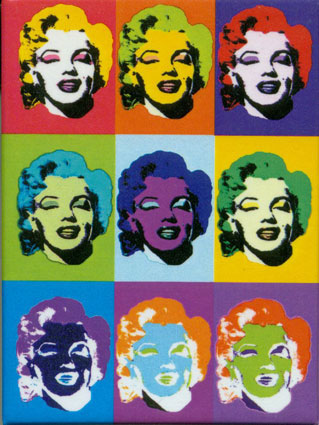
But another book came today, too. And it is, I am afraid to say, a particularly unlovely tome. It parrots the color-block prints of Warhol, but in miniature and with more black that Warhol liked to use. At least this sort of ugliness stems from laziness and is not (I think) the product of careful planning from the folks at Continuum press.

But what is most discomfiting about this book is that its contents are first rate! This is the book! It is a Roger Scruton reader! Scruton's face has been Warholified 16 times and this means that his intellectual gaze is staring me down 16 times! Perhaps this is a joke? Either way, I am simultaneously intimidated by his gaze and appalled by the design. I think it is time to take off the dust jacket and take comfort in the oatmeal-colored boards.

For those yet unfamiliar with Scruton, you might want to consider taking a look at his new book I Drink Therefore I Am and this article, published in last week's Times Literary Supplement. The article is reviewing this book. Here's a teaser:
For Linzey, followers of foxhounds are “animal abusers”, comparable to those who torture cats and dogs for their amusement and who – according to research that he cites without question – are predisposed to become violent criminals when they turn their attention to their fellow humans. I conclude from this that Linzey may be a humane observer of animals, but he is no charitable observer of people. Maybe he cannot bring himself to attend a meet of foxhounds; but he could at least have consulted the literature, from Plato and Xenophon to Turgenev, Sassoon, Masefield and Ortega y Gasset, devoted to the place of hunting in a virtuous life.
Can you tell he enjoys a good hunt?

Monday, October 19

Little Infinity

There are so many articles about the Kindle—about how cute it is, or convenient, or horrible. There's even an article lamenting how it's diminished cultural snobbery. And, of course, there's the long Nicholson Baker article from the New Yorker. Having read twentysomething articles about the Little White e-Book, I decided to stop reading about it.

And then I found, late, this brilliant article with this alluring title: "The Book That Contains All Books." The article is sharper than most on the subject of Kindles, talks about codices (most don't), and at the ends says something worth repeating:
Kindle 2 isn't really about what we may or may not want as readers and writers. It's about what the book wants to be. And the book wants to be itself and everything. It wants to be a vast abridgment of the universe that you can hold in your hand. It wants to be the transbook.
Ugly word "transbook" aside and whether a book actually wills to be something, Marche's comments remind me of that shining example of the short story, "The Library of Babel" by Jorge Luis Borges. The eternal librarian shuffles through the book-filled hexagonal rooms, which altogether create the Library (another word for Universe), which may or may not be infinite, and all the while he fritters away the hours looking for a book that contains all books.

The "discovery" of this perfect compendium, writes the weary librarian-narrator, would be "the capital fact in history." In it there would be
Everything, the minutely detailed history of the future, the archangels' autobiographies, the faithful catalogue of the Library, thousands and thousands of false catalogues, the demonstration of the fallacy of those catalogues, the demonstration of the fallacy of the true catalogue, the Gnostic gospel of Basilides, the commentary on that gospel, the true story of your death, the translation of every book in all languages, the interpolations of every book in all books.
There's something strangely elegant in how the imagination coincides, just even in part, with today's technology. I maintain that the librarian, should he get word of the Kindle, would jump off the side of the great honeycomb Library in the sky—or laugh. To expect a precious "silky vade mecum" all this time!—and then find a bit of plastic jammed with sequences of 0's and 1's instead. I wonder what footnote might Borges append to his story now.

(P.S. On a related note, here's an interesting interview of Umberto Eco on lists from an issue of Der Spiegel. In his thinking, even the laundry list is a "cultural achievement." So are grocery lists and menus. I guess I'm on the slow curve in life for not being a list-maker!)